Point Pleasant, West Virginia · December 15, 1967
46 people died when the Silver Bridge suddenly fell into the Ohio River. What investigators found afterward changed how America inspects its bridges. · 9 min read
The Bridge Collapse That Changed America
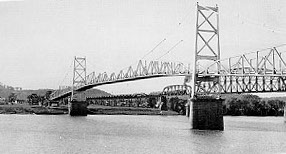
It was Friday evening, December 15, 1967. Christmas was ten days away.
In Point Pleasant, West Virginia, and Gallipolis, Ohio, it was an ordinary holiday rush. The Silver Bridge, the crossing that tied the two towns together, was jammed. Cars sat bumper to bumper over the river. People were heading home from work. Shoppers were carrying Christmas presents across the Ohio.
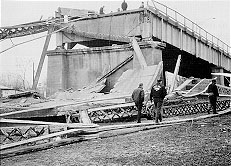
Shortly before 5 p.m., the bridge began to come apart. Within about a minute, the roadway, the steel above it and the vehicles on it had fallen into the river.
Chapter 1
Ten Days Before Christmas
Point Pleasant · Gallipolis
46 lives lost
One bridge. One small structural failure. A disaster that would change bridge safety across the United States.
Thirty-one vehicles were on the bridge when it fell. The people in them were neighbors, commuters, truck drivers and families — most of them from the small river towns on either bank.
Chapter 2
The Bridge Over the Ohio
The bridge opened in 1928, carrying U.S. Route 35 between Point Pleasant and Gallipolis. It was painted with aluminum paint, and that bright metallic finish gave it its name: the Silver Bridge.
Chains instead of cables
Most big suspension bridges hang from thick bundles of steel wire. The Silver Bridge didn't. It hung from chains made of eyebars — long, flat steel bars with a hole, or "eye," at each end. Pins ran through the eyes to link one bar to the next, like a giant bicycle chain draped between the towers.
- 1
Eyebar
A long flat steel bar with a round eye at each end.
- 2
Pin
A steel pin joins the eyes of neighboring bars into a link.
- 3
Chain
Links repeat to form the main chain over the towers.
- 4
Hangers
Vertical members drop from the chain to hold up the road.
The world had also changed since 1928. The bridge was designed in the era of the Model T. By 1967, cars were far heavier, trucks were bigger and traffic was much heavier than its builders had pictured.
Chapter 3
5:00 PM — The Bridge Falls
December 15, 1967
About 5:00 PM
Traffic was stopped and creeping across the bridge. Then one eyebar in the north chain, near the Ohio-side tower, split apart.
Because the link had no backup, the chain let go. With the chain gone, the tower it supported fell, and the collapse ran across the bridge. The main span and both side spans dropped into the river and onto the Ohio bank. According to the federal investigation, the whole structure came down in roughly a minute.
Chapter 4
The Ohio River Becomes a Rescue Scene
People ran toward the river from both towns — police, firefighters, boat operators, emergency crews and ordinary residents. The December water was cold and the current strong, and much of the wreckage lay tangled beneath the surface.
A handful of people survived, some pulled from the water. For most, rescue soon became recovery. Divers and crews worked for days in the cold river, lifting cars and steel from the channel.
- People died
- 46
- People died
- Never recovered
- 2
- Never recovered
- Vehicles on bridge
- 31
- Vehicles on bridge
- Year opened
- 1928
- Year opened
Source: NTSB Highway Accident Report, 1970
Two of the 46 victims were never found.
Chapter 5
The Investigation
How does a whole bridge fall at once? Federal investigators, led by the new National Transportation Safety Board, pieced the wreckage back together. Their attention narrowed to one eyebar — later known as eyebar 330.
Inside the eye of that bar was a tiny crack, about a tenth of an inch deep. It had grown over years from stress corrosion and corrosion fatigue: constant load combined with moisture slowly working into the steel. The crack sat where the eyebar met its pin, hidden under other parts, where inspectors of the time had no practical way to see it.
One day the remaining steel couldn't carry the weight. The eyebar broke, and because the design had no redundancy, one failure took down everything.
One small failure. An entire bridge.
- 1
Hidden crack
A small flaw in the eye of one eyebar.
- 2
Slow growth
Stress and corrosion enlarge it over time.
- 3
Fracture
The eyebar breaks under traffic load.
- 4
Chain fails
With no backup bar, the link lets go.
- 5
Collapse
The tower and spans fall into the river.
Chapter 6
The Disaster That Changed America
The collapse raised an uncomfortable question for the whole country: how many other aging bridges were quietly wearing out? At the time, there was no national requirement to regularly inspect highway bridges.
- 1
Point Pleasant, West Virginia
December 15, 1967.
- 2
National concern
President Johnson convenes a task force on bridge safety.
- 3
Federal action
The Federal-Aid Highway Act of 1968 directs national bridge inspection standards.
- 4
National Bridge Inspection Standards
Adopted in 1971, requiring regular inspections of public highway bridges.
The Silver Bridge wasn't the only reason. Highway officials were already worried about aging infrastructure, and later failures pushed the rules further. But Point Pleasant was the catalyst that turned worry into law.
Every time inspectors examine the critical parts of an American highway bridge today, they're working inside a system shaped in part by lessons from the Silver Bridge. That's why this wasn't only a Point Pleasant tragedy.
Chapter 7
The Legend That Wouldn't Die
Before the bridge fell, something strange had already been happening around Point Pleasant.
In November 1966, two young couples told police they'd been chased by a large winged figure near the abandoned World War II TNT plant north of town. Over the following months, other people reported similar sightings. Descriptions varied, but glowing red eyes came up again and again. Newspapers gave it a name: Mothman.

After the collapse, some people began linking the two. To some, the sightings seemed like a warning. Others think the connection grew afterward, as a frightened town looked for meaning.
History vs. legend
- Documented
“The Silver Bridge fell because of a structural failure.”
The NTSB found that a cracked eyebar in the north chain failed, and the design's lack of redundancy let the whole bridge fall.
- Legend
“Mothman sightings were a warning of the collapse.”
Some people came to believe this after the disaster. There is no evidence connecting the sightings to the bridge. Readers can decide what they make of the legend.
John Keel's 1975 book The Mothman Prophecies, the 2002 film based on it and decades of storytelling turned Mothman into one of America's best-known modern legends. Today the town embraces it with a statue, a museum and an annual festival.
Chapter 8
The Town That Remembers
More than half a century later, the Silver Bridge is still part of who Point Pleasant is. Visitors can see a memorial to the victims near the riverfront, walk the flood-wall murals along the Ohio, stop at the Mothman statue and museum downtown, and drive out to the McClintic Wildlife Management Area, where the old TNT bunkers still stand.
Chapter 9
Then & Now
Then — 1928
Now — 2019

The Silver Bridge was never rebuilt. In 1969, the Silver Memorial Bridge opened about a mile downstream, reconnecting Point Pleasant and Gallipolis and carrying U.S. 35 across the Ohio once again.
Chapter 10
Remembering the 46
46 people. 46 lives. A community that never forgot.
Their names are inscribed on the Silver Bridge memorial in Point Pleasant.
The Silver Bridge disappeared into the Ohio River in about a minute. But what happened in Point Pleasant didn't stay there. The lessons of that December evening helped change the way America watches over its bridges.
Some disasters become history. Others change what happens next.
Sources & Further Reading
- NTSB Highway Accident Report: Collapse of U.S. 35 Highway Bridge, Point Pleasant, W. Va. (1970)
Official federal investigation of the collapse.
- Federal Highway Administration — Bridge Inspection
History and requirements of the National Bridge Inspection Standards.
- Wikipedia — Silver Bridge
Overview of the bridge, collapse and replacement.
- Wikipedia — Mothman
The 1966–67 sightings and the legend.
Know someone who remembers?